

Riding Against the Odds: How Nana Kakyiri Is Redefining What It Means to Be an Equestrian
From the moment five-year-old Nana Kakyiri felt the rhythm of a horse beneath her on a Ghanaian beach, something ignited. That single ride became the foundation of a journey defined by passion, perseverance, and the courage to exist loudly in spaces that weren't built for her.
Though she didn't begin formal training until age 13—later than many of her peers—Nana's love for horses had been cultivated through years of watching Horseland, The Saddle Club, and My Little Pony. Those fictional stories planted seeds that would grow into something revolutionary: a Black woman carving out space in one of the world's most exclusive sports.
The Lightning Bolt Moment
Every great partnership has an origin story. For Nana, it began with reluctance.
When her trainer first suggested she try Santiago, she resisted. The horse was massive. She was, in her own words, "abnormally short." Past experience told her they wouldn't mesh. But her trainer persisted: "We've been watching this horse for a year. Trust me, he's a saint. He keeps everyone safe at big jumps."
The deal was simple: sit on him for 20 minutes. If it didn't work, she could walk away.
The first 30 seconds were nerve-wracking. So much so that when asked to change direction, Nana went across the diagonal and continued in the same direction. But around the 10-minute mark, everything shifted. "Almost like a bolt of lightning rushed through me and through Santiago," she remembers. In that instant, she knew. This wasn't just any horse. This was her horse.
Santiago gave Nana more than championships and technical skill. He gave her confidence she didn't know she could possess. He taught her what it means to be truly seen, understood, and supported. "He's given me friendship, understanding, and unwavering devotion," she says—a bond that transcends sport.
What Horses Teach About Love
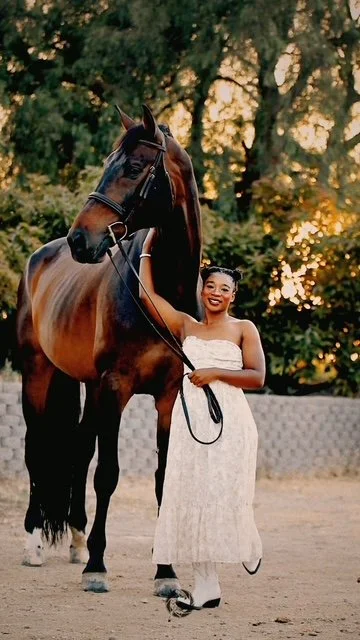
Ask Nana what riding has taught her, and she'll tell you about humility. About presence. About the privilege of being trusted by a 1,200-pound animal that could easily choose not to cooperate.
"Horse riding is a demanding sport, and the lifestyle is very underestimated," she explains. "It's truly a blood, sweat, tears commitment." Every ride carries risk. Every day requires you to decenter yourself and prioritize another living being. "This is why I always say only horse people really know what true love feels like."
In the saddle, Nana finds meditation. It's about being fully synced with Santiago's movements, knowing exactly where he is mentally and physically, trusting instinct over overthinking. "Sometimes you even hear their voice," she says. When that connection locks in, nothing else exists. No noise. No pressure. Just two beings moving as one.
For spectators, Nana hopes they see beyond technical precision. She wants them to understand that what looks effortless now was forged through years of falling, failing, and fighting to stay in a sport that didn't always welcome her.
The Invisible Rider
The stares started early. So did the comments.
As a Black equestrian in a predominantly white sport, Nana often found herself the only person of color in arenas filled with thousands. Statistics bear this out: only 0.016% of competitive equestrians in the United States are Black. For years, those stares felt intimidating, even humiliating. The isolation was real. The self-doubt was crushing. Trainers said things that stuck with her for years, eroding confidence that took just as long to rebuild.
"People see the wins and the highlights now," Nana reflects, "but not the past 7–8 years where I felt isolated in the sport. I didn't always have the horses that could take me to the top. There were times I was falling off every other day."
But somewhere along the way, the weight of being different transformed into power. Nana stopped shrinking and started standing out. She stopped waiting for permission and started claiming space. "I love being a source of representation for others who may feel like they don't belong," she says now.
Her social media became a beacon. Messages flood in daily with parents thanking her for giving their children someone to look up to, riders saying she kept them from quitting, newcomers crediting her with getting them into the sport in the first place. "Sometimes I forget the power of my voice and platform," she admits. "But seeing how people have found a place in this sport because of my content, that means everything."
Advocacy Without Losing the Joy
Nana's platform doesn't shy away from hard truths. She addresses the issues plaguing equestrian sport head-on. But she also refuses to let those issues define the narrative entirely.
"The world doesn't need another sport that takes itself too seriously," she laughs. Her page is a mix of education and celebration, critique and joy. She brings important conversations to light, then pivots to moments that make people smile. Balance, she says, is everything.
When it comes to making the sport more inclusive, Nana is clear: representation is the answer. "A lot of people equate diversity issues in equestrian sport to money," she explains, "but that's not true. It paints a false narrative that all POC equestrians are low-income, which isn't accurate." Financial challenges affect riders at every level, regardless of race. The real issue is visibility.
"POC riders are not being shown to the world. Their voices and successes are swept to the side. When you don't see yourself in the sport, you can't envision yourself succeeding, so you don't join." Her message to other Black riders is simple and powerful: "The best thing you can do is be happy and succeed, whatever that looks like to you. Black success is a revolution."
Eyes on the Prize
Nana's ambitions are as bold as her journey. By the end of 2026, she aims to compete at the 1.20m level. Eventually, she wants to go pro. And then? Represent Ghana—her birthplace, her heritage—in the Olympics. She would be the first.
But her dreams extend beyond personal achievement. She envisions a future where the next generation of Black equestrians doesn't have to fight as hard for belonging. Where the sport is kinder, more welcoming, more reflective of the world beyond its traditional gates. "I just want to see them succeed and be happy," she says simply.
Rewriting the Narrative
Nana's story isn't just about mastering a sport. It's about the transformative power of visibility. The courage it takes to be first. The resilience required to keep showing up when the arena doesn't look like you. And the love—for horses, for community, for the next kid watching from the sidelines wondering if there's space for them too.
In every ride, Nana proves there is. And in doing so, she's not just competing. She's redefining what it means to belong.
